HVAC Market Outlook: Why July 2026 Could Signal a Demand Rebound [Infographic]
After a rough 2025 marked by weak buying sentiment and softer shipment activity, the HVAC market is starting to show signs of movement again. Buying intent is edging up, recent shipment data points to improvement, and summer seasonality could put July 2026 in a stronger position than last year.
That does not mean the market gets easy overnight. Higher equipment prices, tighter household budgets, and margin pressure are still very real. But for contractors, distributors, and manufacturers, the message is clear: the companies that plan ahead now will be better positioned when demand starts to pick up.
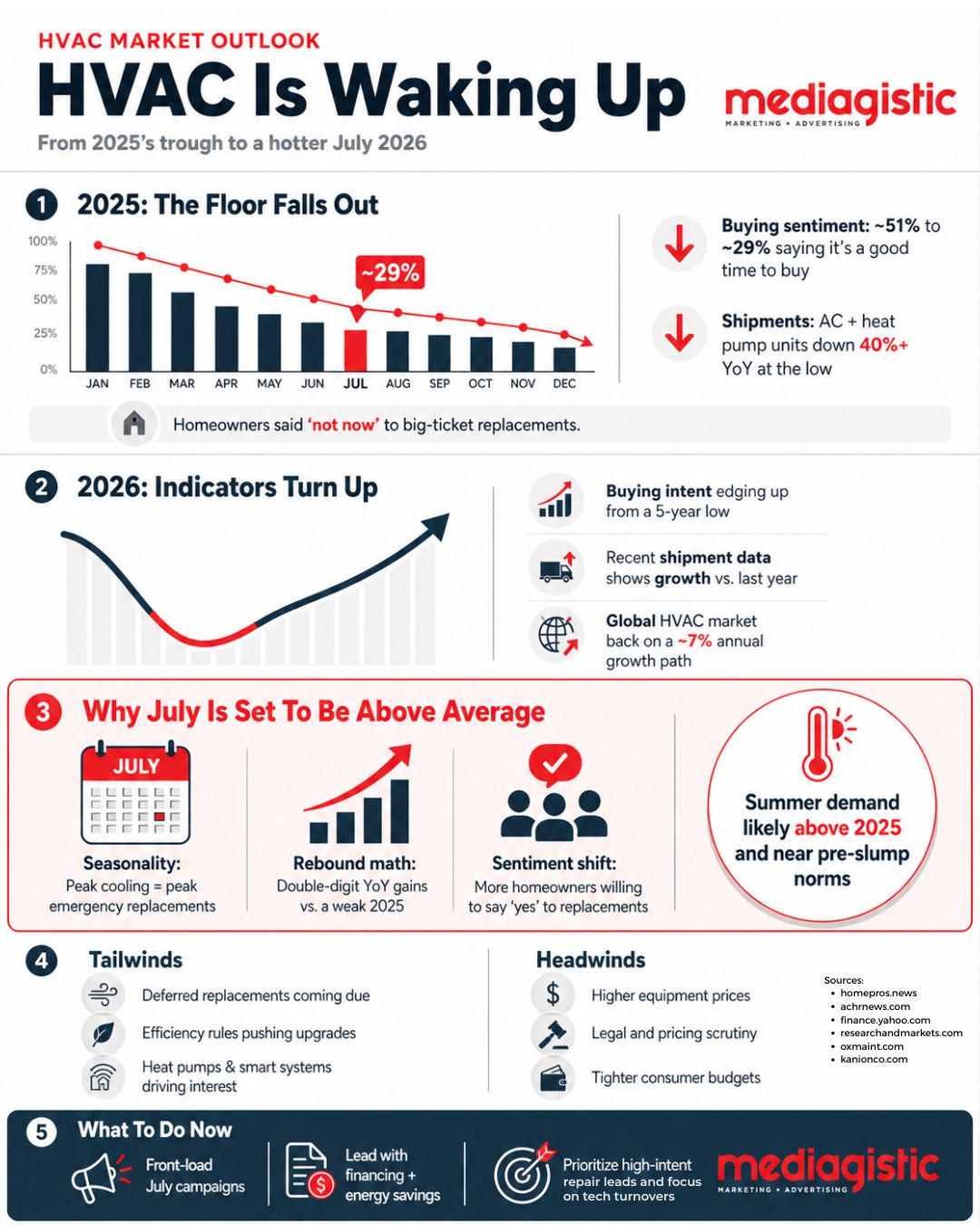
The infographic below offers a quick look at the key signals, tailwinds, headwinds, and recommended next steps for the months ahead:
What the HVAC Market Signals Mean
The HVAC market appears to be moving from contraction into recovery. After a difficult 2025, several indicators suggest demand may be waking back up in 2026, especially as the industry moves into peak cooling season.
That said, this is not a “business as usual” rebound. Contractors, distributors, and manufacturers are still dealing with price sensitivity, tighter household budgets, financing friction, and margin pressure. The companies that win will be the ones that read the market clearly and act before demand fully arrives.
2025 Created Deferred Demand
In 2025, many homeowners delayed major replacement decisions. Buying sentiment for major household items fell sharply, with 29 percent of consumers saying it was a good time to buy in December 2025, down from 51 percent in January. When consumer confidence drops and household budgets get tighter, HVAC replacements often get pushed off unless the system fails completely.
That kind of delay does not erase demand. It stores it up.
Aging equipment, repair fatigue, comfort issues, refrigerant changes, and efficiency concerns continue building in the background. By the time homeowners re-enter the market, many are not starting from curiosity. They are starting from necessity.
For contractors, that means the next demand cycle may include a larger pool of homeowners who have already delayed a purchase once and are now closer to making a decision.
July 2026 Could Be a Key Demand Window
July is already one of the most important months in HVAC because heat creates urgency. When temperatures climb, weak systems get exposed. Repair calls increase. Replacement conversations become more immediate.
The difference in 2026 is the comparison point. In July 2025, combined shipments of central air conditioners and air-source heat pumps fell 26.8 percent year over year. Against that weaker base, year-over-year gains in July 2026 could look especially strong. That creates opportunity, but it also creates noise. Contractors should not mistake a short-term spike for a permanent market shift.
The smart move is to treat July as a critical capture window. That means having campaigns live early, making sure lead handling is tight, and preparing sales teams to move quickly when high-intent demand shows up.
The Rebound Will Still Have Friction
A stronger market does not mean an easier sale. Homeowners may be more willing to replace than they were in 2025, but many will still be cautious about cost.
Higher equipment prices and tighter budgets put more pressure on the sales process. Equipment pricing pressure, financing, energy savings, rebate education, and clear replacement math become more important. A homeowner may need the system, but they still need help seeing how the investment fits their budget.
This is where messaging matters. Contractors should avoid generic “buy now” promotions and focus on practical reasons to act: comfort, reliability, lower operating costs, warranty protection, available financing, and avoiding another emergency repair.
Contractors Should Front-Load Their Marketing
Waiting until demand peaks is like opening an umbrella after you are already soaked.
Contractors should be building visibility before July. That includes paid search, LSAs, SEO, Google Business Profile activity, Yelp, social proof, email campaigns, and remarketing to repair customers who may be close to replacement.
The goal is simple: when homeowners start searching, the contractor should already be visible, trusted, and easy to contact.
That also applies to AI search. As more consumers use AI-powered tools to compare options, ask local service questions, and research replacement decisions, contractors need consistent signals across the web. Reviews, service pages, local listings, structured content, and clear brand authority all matter.
Distributors and Manufacturers Have a Role to Play
This is not just a contractor story. Distributors and manufacturers should be looking at this as a channel readiness moment.
If demand improves, dealers will need help moving faster. That could mean timely campaign support, co-op guidance, financing assets, product education, sales enablement, and stronger local marketing programs.
The best support will be practical and easy to activate. Dealers do not need another folder full of generic assets. They need campaigns, messaging, and tools that help them capture replacement demand in their own markets.
The Bottom Line
The HVAC market may be waking up, but growth will not be automatic. Global HVAC market forecasts continue to point toward long-term growth, including rising interest in smart HVAC systems, heat pumps, and connected maintenance technology. July 2026 could create a stronger demand environment, especially compared to a weak 2025. But legal and pricing scrutiny, cautious consumers, and competitive markets will still shape the outcome.
Ready to Capture the Next HVAC Demand Wave?
If July 2026 brings stronger HVAC replacement demand, the contractors who prepare early will have the advantage. Mediagistic helps HVAC businesses turn market signals into practical growth plans, from paid media and SEO to local visibility, AI-powered lead handling, and revenue tracking.
If you want to build a smarter plan before peak demand hits, schedule a strategy conversation with our team.
You May Also Like

Google LSAs’ Lead Charge Policy Is Changing Oct. 1: What Contractors Need to Know
September 10, 2026For home services contractors running Google Local Services Ads, answering the phone is about to have an even more direct impact on… Continue Reading Google LSAs’ Lead Charge Policy Is Changing Oct. 1: What Contractors Need to Know…

Mediagistic and Contractor Commerce Help Contractors Turn More Website Traffic Into Revenue
September 3, 2026The partnership connects marketing, website conversion and online buying to create a better homeowner experience and more value from every lead. TAMPA,… Continue Reading Mediagistic and Contractor Commerce Help Contractors Turn More Website Traffic Into Revenue…

6 Common Phishing Scams that HVAC Business Owners Need to Know
August 28, 2026For HVAC business owners, managing a growing home-service company means you’re constantly on the go. You’re juggling dispatch boards, supply house orders,… Continue Reading 6 Common Phishing Scams that HVAC Business Owners Need to Know…