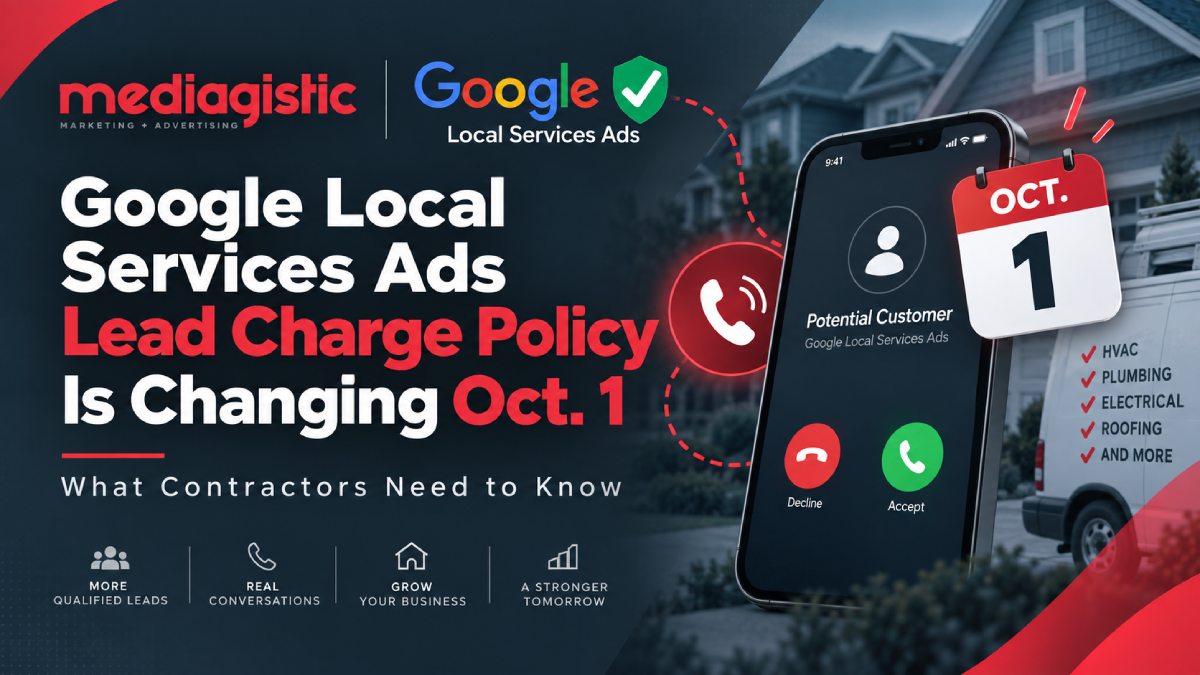
Google LSAs’ Lead Charge Policy Is Changing Oct. 1: What Contractors Need to Know
For home services contractors running Google Local Services Ads, answering the phone is about to have an even more direct impact on advertising costs.
Starting October 1, 2026, Google is updating its Local Services Ads lead charge policy. Under the new rules, certain missed calls and subsequent calls can qualify as billable leads, even when your team never actually speaks with the customer.
For HVAC, plumbing, electrical and other home services businesses, this is more than a small billing change. It makes call handling, routing and speed-to-lead an even bigger part of LSA performance.
What Is Changing With Google Local Services Ads?
The biggest change (announced in an email sent to advertisers at the end of August) involves missed calls during your listed business hours. Under Google’s valid lead criteria, if a potential customer calls your business through a Local Services Ad, remains on the line for more than 20 seconds, and nobody answers, Google can now count that missed call as a valid lead and charge for it.
In other words, not answering the phone doesn’t necessarily mean you avoid paying for the lead. Google says the change is intended to encourage responsiveness because consumers using Local Services Ads often have an immediate need and expect to quickly connect with a local provider.
That expectation is especially relevant in home services. Someone searching for emergency AC repair when their house is 85 degrees probably isn’t planning to leave three voicemails and wait until tomorrow. They’re calling the next company.
There’s an Important Exception for IVR Call Routing
Contractors using an interactive voice response system, or IVR, should pay close attention to how their phone routing is configured. An IVR is the type of system that asks callers to press a key before being connected to a department or representative.
According to HomePros, “If a business’s inbound call setup requires callers to press a key to route them to a specific department, the 20-second timer will start when the caller presses the key, according to the email. Advertisers won’t be charged if customers don’t press the key.” So when a customer has to press a key before being routed, Google’s 20-second timer doesn’t begin until that selection is made. If the customer never presses a key and is never routed, the business won’t be charged under this missed-call rule.
That creates an important distinction between an IVR and other automated answering technology. Contractors using AI answering services, auto-attendants or more complicated call-routing workflows should review exactly what happens after an LSA caller dials the number. A phone system technically answering the call isn’t the same thing as successfully connecting that homeowner with someone who can help.
Follow-Up Calls Matter Too
Another part of Google’s update could easily get overlooked. If a customer’s initial call doesn’t qualify as a charged lead, a later call between that customer and the business may still become chargeable if it meets Google’s valid-lead criteria.
For example, imagine a homeowner calls through your Local Services Ad but hangs up before reaching the 20-second threshold. That first call may not qualify as a lead. If the homeowner calls again later and the interaction meets Google’s criteria, that subsequent call may be charged.
This puts more pressure on contractors to handle each opportunity efficiently. It’s not just about answering the first call. It’s also about getting the customer to the right person, resolving questions quickly and moving them toward a booked appointment without unnecessary back-and-forth.
The fewer times a high-intent homeowner has to call you, the better the experience for the customer and the more efficiently your team can handle the lead.
Responsiveness Can Also Affect Your LSA Ranking
The financial impact of a missed call is only part of the equation. Google already lists responsiveness to customer inquiries and requests as a factor in the Local Services Ads auction, and Google specifically notes that missed calls may negatively affect responsiveness.
LSA rankings can also consider factors including:
- Your bid
- How likely your ad is to generate a lead
- Responsiveness to customer inquiries
- Relevance to the customer’s search
- Reviews and ratings
- Average response time
- Profile quality and completeness
- Verification information
- High-quality photos
Google also advises businesses to respond to as many leads as possible because regularly failing to answer calls or messages may affect ad ranking. That means call responsiveness can potentially affect a contractor twice: you could pay for a missed opportunity, while a pattern of poor responsiveness could also make it harder for your ads to compete for future opportunities.
That creates some healthy pressure for contractors to tighten up their call-handling processes. Faster responses help build trust with potential customers, while consistent responsiveness also gives Google stronger signals that the business is active, reliable and prepared to handle new leads.
Call Handling Is Part of Your Advertising Strategy
Contractors have traditionally treated advertising and call handling as two separate functions. Marketing generates the lead, and the CSR team answers the phone. That separation makes less sense every year.
If you’re paying Google to generate phone calls, what happens to those calls is part of your marketing performance. A campaign producing 100 calls isn’t successful just because the phone rang 100 times. You need to know what happened after those calls came in.
- How many calls were answered?
- How quickly were they answered?
- How many reached the right CSR or department?
- How many booked an appointment?
- How many required multiple calls?
- How many ultimately generated revenue?
Google’s latest LSA change makes those operational questions harder to ignore. Media performance and call-center performance are becoming increasingly connected, and contractors that treat them as separate systems risk wasting otherwise valuable leads.
What Contractors Should Do Before October 1
Now’s a good time to audit the path between an LSA click and a booked job.
1. Review your listed business hours. Make sure the hours associated with your Local Services Ads accurately reflect when someone is available to handle incoming calls.
2. Test your call routing. Call your own business number and go through the process as a homeowner would. Look for long hold times, unnecessary menus, routing loops or other friction.
3. Review your IVR configuration. Understand when callers are asked to make a selection and what happens after they do.
4. Evaluate missed-call coverage. If your CSR team can’t consistently answer during business hours, consider overflow coverage, AI answering technology or another process for reducing missed opportunities.
5. Measure more than lead volume. Connect advertising performance to answered calls, booked appointments, closed jobs and revenue whenever possible.
6. Train CSRs around speed-to-lead. An LSA caller is usually a high-intent prospect. Treating that call like a routine inbound inquiry can mean losing the customer to the next contractor in the search results. Check out our CSR Call Script Planning Guide to get started improving how your CSRs handle inbound calls.
7. Evaluate your after-hours answering service. Secret-shop your current provider to make sure they know your services, answer with the correct business name and can confidently handle common customer questions. Poor handoffs can lead to hangups and wasted LSA opportunities. As an alternative, consider implementing an AI CSR solution for nights, weekends and holidays to keep leads moving when fewer competitors may be actively answering the phone.
The Bigger Picture: Google Wants Better Customer Experiences
Google’s direction here makes sense when you look at Local Services Ads from the homeowner’s perspective. The customer isn’t clicking an ad because they want to generate a lead for an HVAC contractor. They want someone to fix their air conditioner.
Google’s job is to connect that person with a business that’s likely to respond and solve the problem. Its Local Services Ads ranking system already rewards signals associated with quality and responsiveness, and this policy update adds another financial incentive for advertisers to provide that experience.
For contractors, generating the phone call is only half the job. The businesses that answer quickly, route calls correctly and convert more opportunities on the first interaction will be in a much better position to get more value from every advertising dollar.
At Mediagistic, we help home services businesses connect advertising performance with what happens after the lead comes in, from paid media and Local Services Ads to lead handling and revenue analytics. The number that matters most isn’t how many times the phone rings. It’s how many of those calls turn into customers. Get in touch with our team today to learn more.
You May Also Like
Mediagistic and Contractor Commerce Help Contractors Turn More Website Traffic Into Revenue
September 3, 2026The partnership connects marketing, website conversion and online buying to create a better homeowner experience and more value from every lead. TAMPA,… Continue Reading Mediagistic and Contractor Commerce Help Contractors Turn More Website Traffic Into Revenue…

6 Common Phishing Scams that HVAC Business Owners Need to Know
August 28, 2026For HVAC business owners, managing a growing home-service company means you’re constantly on the go. You’re juggling dispatch boards, supply house orders,… Continue Reading 6 Common Phishing Scams that HVAC Business Owners Need to Know…

Yelp Announces OpenAI Partnership: What It Means for HVAC Leadgen & AI Visibility
July 27, 2026Yelp just announced a formal partnership with OpenAI, and it could have a meaningful impact on both organic AI visibility and paid… Continue Reading Yelp Announces OpenAI Partnership: What It Means for HVAC Leadgen & AI Visibility…