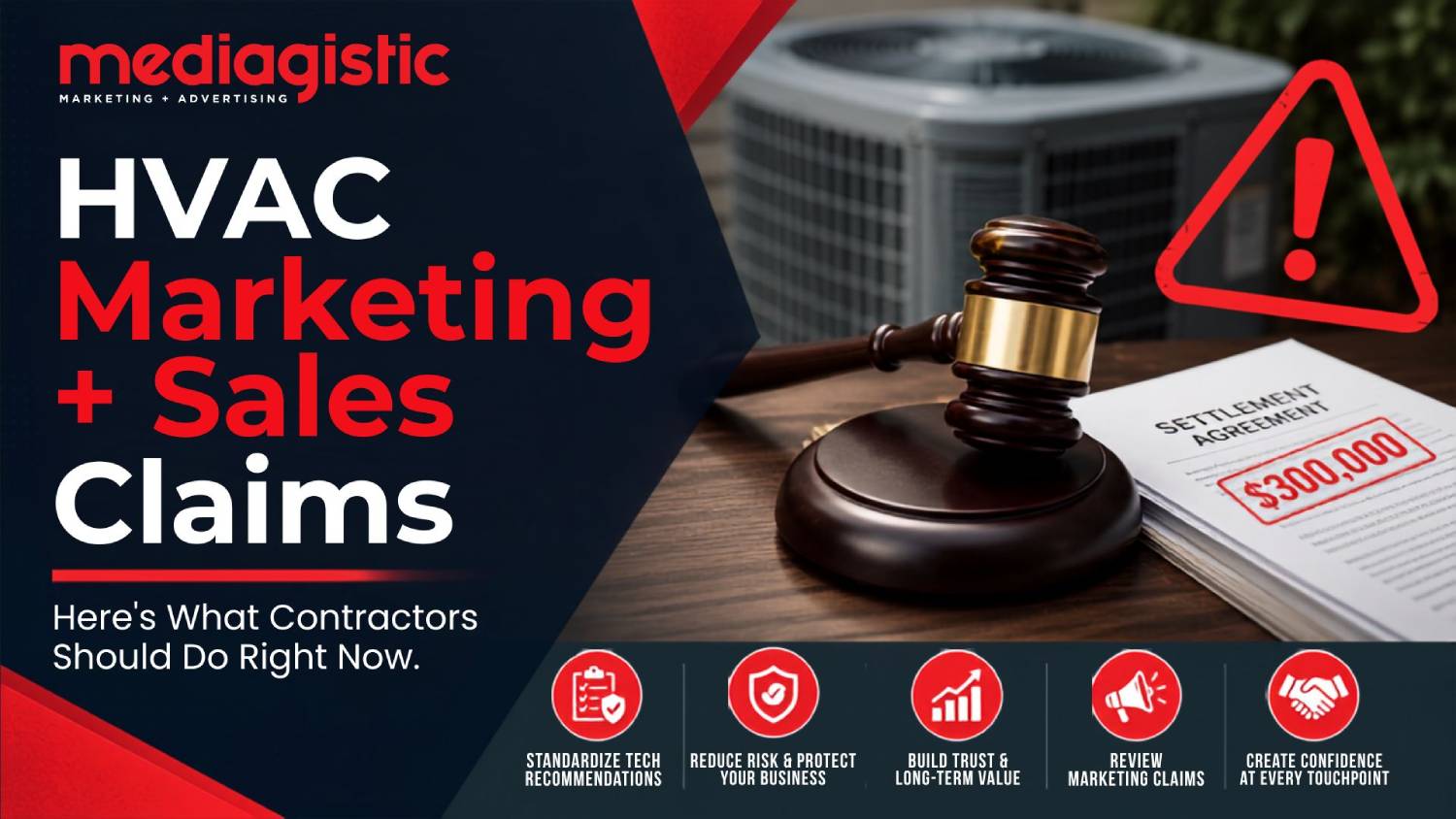
HVAC Sales & Marketing Claims: How Contractors Can Reduce Risk and Build Trust
Another warning shot for the HVAC industry. As reported by Homepros News, a recent $300,000 settlement serves as a reminder of how quickly sales and marketing claims can become a business risk.
While most contractors would never intentionally mislead a homeowner, cases like this highlight a larger challenge facing the industry: how do you make replacement recommendations consistently, ethically, and in a way that homeowners trust? The answer isn’t selling harder. It’s building a process that relies on evidence instead of pressure.
Read on for practical steps contractors can take to reduce risk, standardize technician recommendations, and review marketing claims before they create trust issues.
Quick note: This article is intended for educational and informational purposes only and should not be considered legal advice. Contractors with questions about compliance, advertising claims, sales practices, or consumer protection laws should consult qualified legal counsel familiar with their market and business operations.
The Real Problem Isn’t Sales. It’s Subjectivity.
When contractors hear “deceptive sales practices,” they often picture a comfort advisor making questionable claims in the home. In reality, the bigger issue is inconsistency and lack of an intentional, replicable system.
Two technicians can look at the same system and reach different conclusions. One recommends repair. Another recommends replacement. Without a documented process for evaluating equipment and communicating recommendations, businesses expose themselves to unnecessary risk and create confusion for homeowners.
Add into the mix rising equipment costs, changing consumer sentiment, and increasing pressure to generate replacement revenue, and the risk becomes even greater. Most technicians and comfort advisors aren’t trying to mislead homeowners, but when recommendations are based on subjective judgment rather than a documented process, it’s easier for well-intentioned conversations to be perceived as exaggerated, inconsistent, or unnecessarily aggressive.
Why Fear-Based Selling Creates Risk
Educating homeowners about the consequences of delaying a repair is part of the job. The problem starts when education turns into pressure.
Statements like “your system could fail soon, so I recommend replacment based on the following factors…” are very different from statements like “your system will fail soon” or (even worse), “your system is getting ready to explode.” The first one is a professional and diagnostic assessment. The other two can sound like a prediction or scare tactic, which can be legally problematic.
The strongest contractors don’t rely on fear to drive decisions. They rely on facts, findings, basic replacement math (i.e. “the $5,000 rule” based on system age x repair cost), and documentation.
Build a Repeatable, Evidence-Based Technician Turnover Process
Many leading HVAC companies have moved toward structured system evaluation processes. Instead of asking homeowners to trust a technician’s opinion alone, they provide documentation that explains exactly how a recommendation was reached.
A System Health Report or equipment scorecard creates consistency across the organization and helps homeowners understand their options. An effective process should include:
- A standardized evaluation of system age, condition, efficiency, safety concerns, repair history, and performance.
- Consistent scoring criteria that help determine whether repair or replacement is the better option.
- Documentation that supports recommendations with facts rather than opinions.
- Consultative conversations focused on options, risks, and long-term outcomes.
- A nurture process for homeowners whose systems may become replacement candidates later.
This approach was the focus of Mediagistic’s 2025 Service-to-Installation webinar, which explored how contractors can use system health reporting and customer education to identify legitimate replacement opportunities while building trust with homeowners.
This Goes Beyond Sales and Into Marketing
The same standard should apply to your marketing. If a recommendation needs to be supported by evidence in the home, it should also be supported by evidence on your website, in your advertising, and throughout your customer communications.
Take a fresh look at:
- Website service pages
- Google Ads and social media ads
- Financing promotions
- Call center and CSR scripts
- Email marketing campaigns
- Repair versus replacement messaging
- Maintenance agreement promotions
Ask these simple questions for any sales or marketing communication that your company puts out: Could a homeowner reasonably misunderstand what we’re saying? Is the tone of this communication educational, grounded in fact and based on a diagnostic process? If the answers are “yes” and “no” respectively, then it’s probably worth revisiting.
Need Help Reviewing Your Marketing and Customer Journey?
Many of the issues that create risk are not obvious until someone takes a fresh look at your business. Sometimes the challenge is marketing language. Sometimes it’s a sales process. Sometimes it’s the way technicians are presenting recommendations in the home.
If you’d like a second set of eyes on your marketing, lead generation, customer communications, or service-to-install process, Mediagistic offers a complimentary Market Fit Analysis. We’ll review your digital presence, messaging, customer journey, and growth opportunities to help identify ways to strengthen trust, improve performance, and create a better experience for homeowners. Talk to an HVAC marketing expert to schedule your Market Fit Analysis today.
You May Also Like

Google LSAs’ Lead Charge Policy Is Changing Oct. 1: What Contractors Need to Know
September 10, 2026For home services contractors running Google Local Services Ads, answering the phone is about to have an even more direct impact on… Continue Reading Google LSAs’ Lead Charge Policy Is Changing Oct. 1: What Contractors Need to Know…

Mediagistic and Contractor Commerce Help Contractors Turn More Website Traffic Into Revenue
September 3, 2026The partnership connects marketing, website conversion and online buying to create a better homeowner experience and more value from every lead. TAMPA,… Continue Reading Mediagistic and Contractor Commerce Help Contractors Turn More Website Traffic Into Revenue…

6 Common Phishing Scams that HVAC Business Owners Need to Know
August 28, 2026For HVAC business owners, managing a growing home-service company means you’re constantly on the go. You’re juggling dispatch boards, supply house orders,… Continue Reading 6 Common Phishing Scams that HVAC Business Owners Need to Know…